UX/UI DESIGN for SAAS
An Arcade-Style Desktop Platform that brings Culture to the Remote Workplace
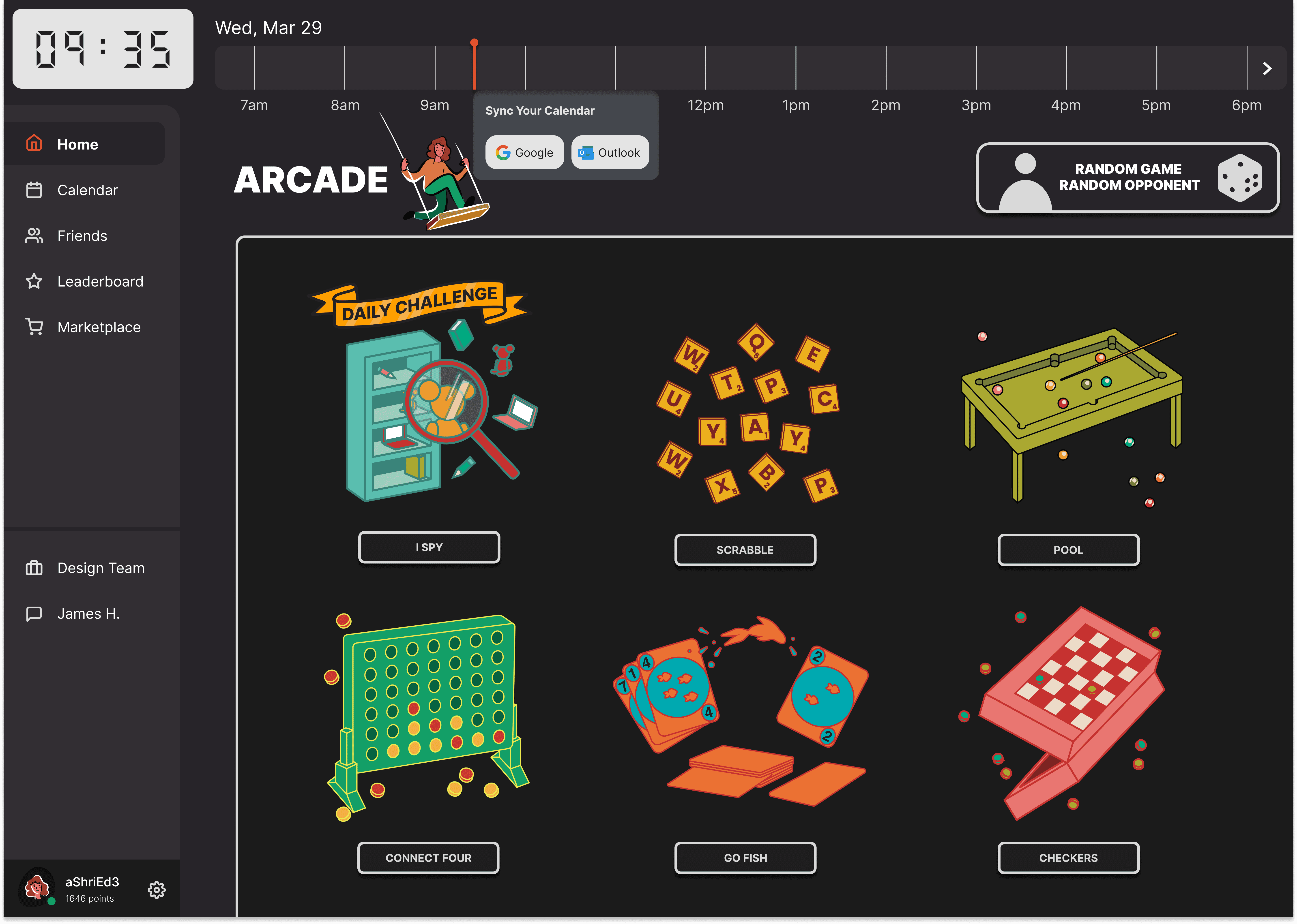
How might we encourage remote workers to incorporate productive social breaks into their schedules, using multi-player games and friendly coworker competition?
Team
1 UX Researcher, 1 UX Designer, & 2 UI Designers
Tools & Skills
Figma, FigJam, Adobe Creative Suite, & Procreate
Surveys, User Interviews, Affinity Mapping, User-Centered Design Methodology, User Personas, User Flows, Storyboarding, Wireframing, Usability Testing, Prototyping
Duration
January – May 2023 (ID 4824 Interaction Studio)
May – August 2023 (Create-X Startup Program)
Remote work has brought many advantages but also significant challenges, particularly around maintaining mental and physical health. We identified three main issues for remote workers through user research:
📌 Weak Separation between Work and Home
Deep focus is hard to maintain while working remotely. Workers are constantly multitasking, swapping between screens, projects, and tasks rapidly. The same distractions that occur in an office, also occur at home; sometimes, due to the nature of being remote, requires the user to make their own personal changes to combat these distractions.
📌 Unstructured Breaks
In unstructured settings, people have difficulty taking restful breaks. In the office, many ate lunch with their laptops out, continuing to work and never taking a full break. Remote break times are often inconsistent and it can be difficult to self motivate healthy break habits. Active breaks (cooking, chores, physical activity) and social breaks are effective in refreshing workers. It’s hard to coordinate breaks with coworkers in sync.
📌 Lack of Informal Coworker Interaction
Social interaction is key to both health & productivity, and remote workers don’t get enough. Meetings and coworker communications are almost entirely online, and personal conversation with deskmates was limited. Lack of casual and spontaneous interactions over remote work makes it harder to understand colleague’s work and POVs. People are only available for formal, scheduled interaction. There is a lack of "Water Cooler Talk".
Our goal was to support remote workers in establishing a routine that prioritizes their well-being, fosters healthier break habits, and promotes stronger coworker relationships.
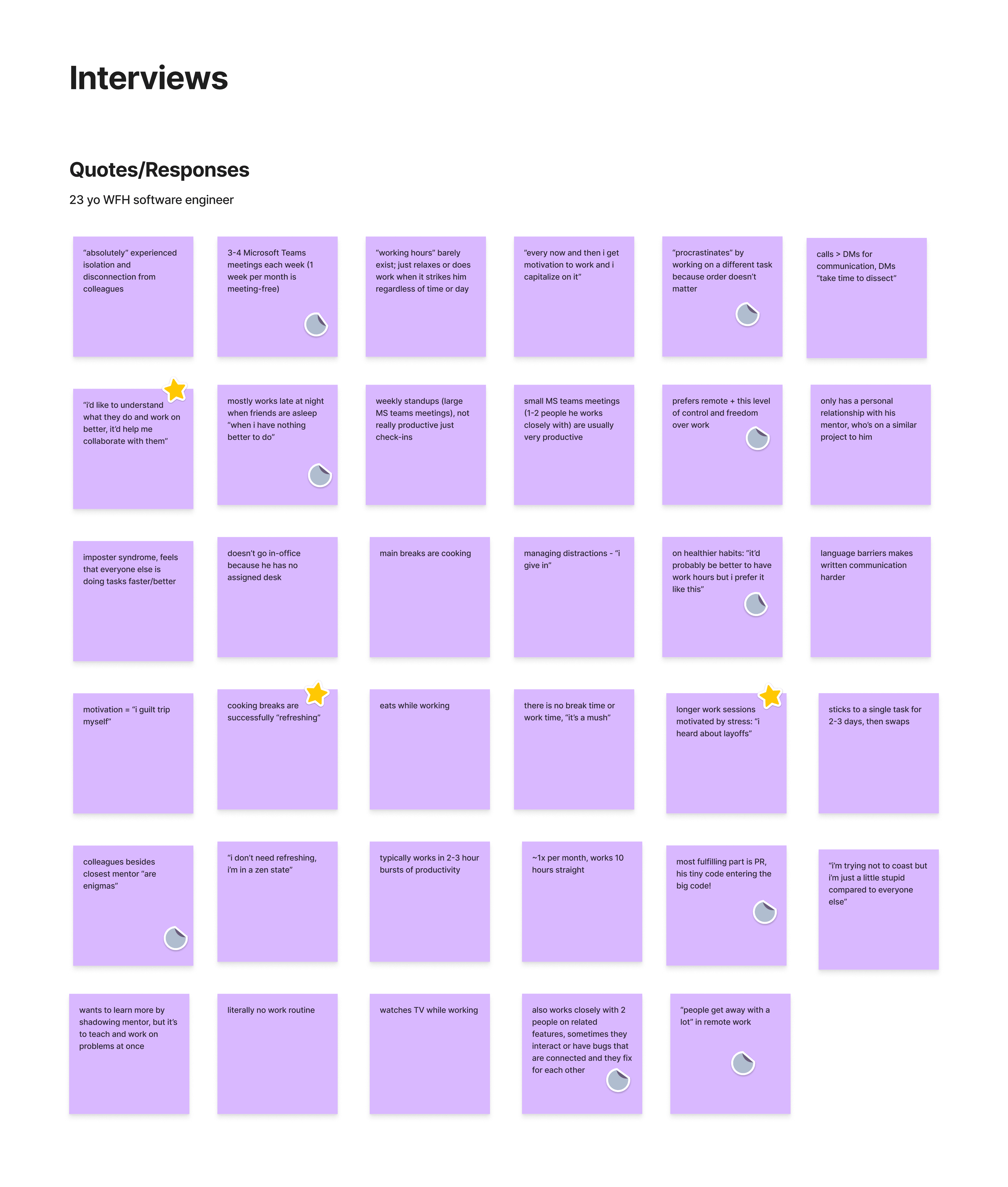
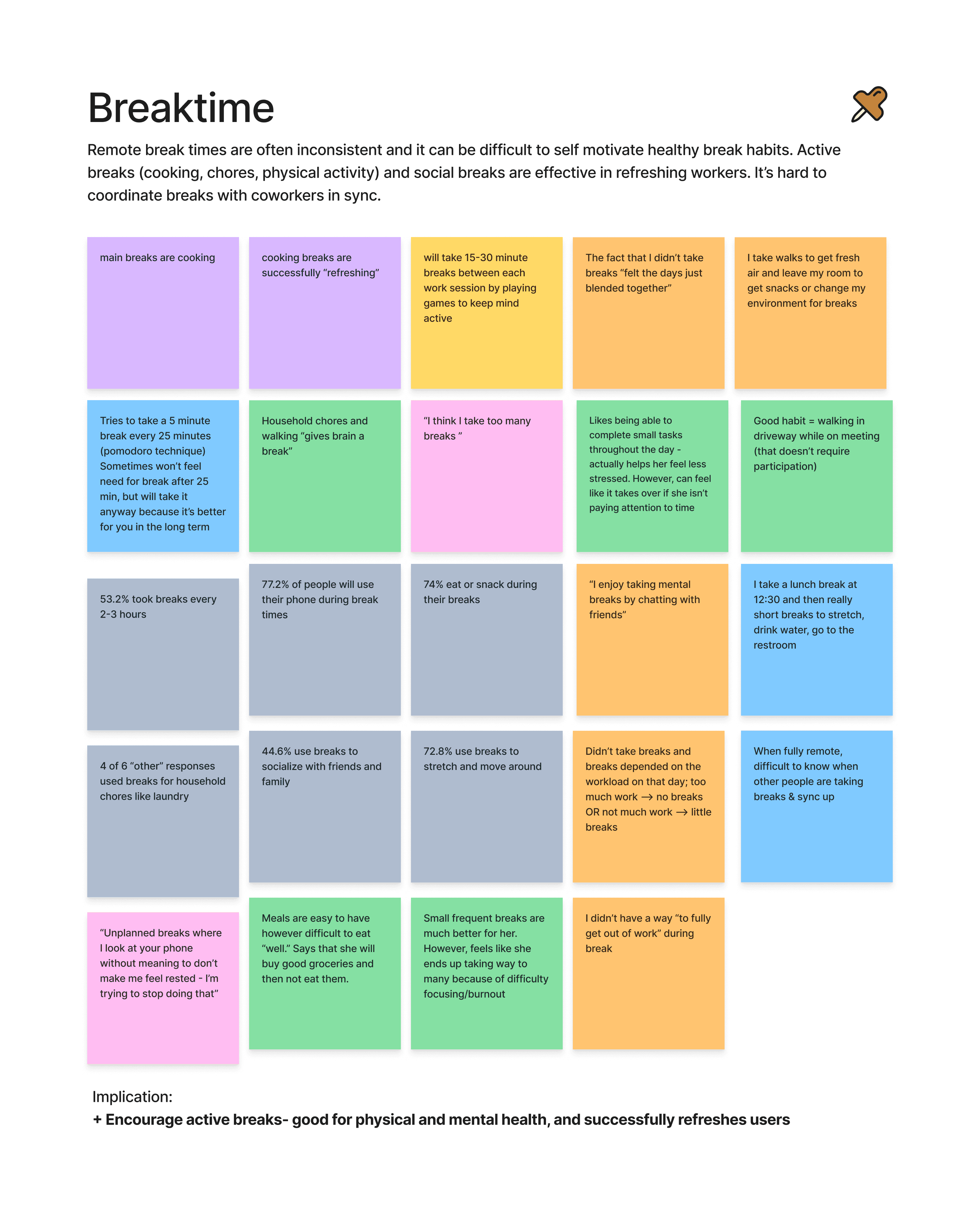
Data Analysis: Affinity Map of 150 interview quotes from 6 interviews and 16 key statistics from 99 survey responses, grouped into 10 main themes
To address the unique user insights of remote workers, we engaged our users in the co-design process to generate novel ideas and insights, designed a platform with features tailored to address these challenges, and conducted usability tests to evaluate our prototype's satisfaction and efficiency
🎯 Participatory Design Research
Users showed preferences for: scheduling their own breaks, multiple brief socialization breaks after lunch, 1v1 and multiplayer games encouraging competition, asynchronous, low commitment games, and tools that assist in incorporating more social interaction and fun into their days.
During this phase, our participant, a software engineer, asked, "Why would I use this?" This feedback led to the development of the Marketplace feature, where users can exchange points gained from games for company rewards.
🎯 Key Design Features
Scheduled Breaks: Allowing users to set their own break times
Socialization Breaks: Multiple brief breaks after lunchtime
1v1 and Multiplayer Games: Encouraging competition with the flexibility of "free play"
Asynchronous Games: Low commitment games that can be played at any time
🎯 Usability Testing
Using the "Think Aloud" method, our main data collection included:
Screen and Audio Recording: Capturing users' actions and thoughts
Error Analysis: Counting the number of errors per task and noting timestamps and locations in the prototype
Post-Testing Interviews: Using Likert scale ratings and open-ended questions to gather data on visual appeal, emotional impact, intuitiveness, logical flow, user interest, and alignment with users' mental models.
🎯 Post-Usability Testing Results
Our usability testing revealed several key insights into the platform's efficiency, satisfaction, and aesthetics:
Efficiency:
Time on Task: The total time to complete tasks was 04:22, well within the goal of under 10 minutes, making it perfect for short breaks.
Gameplay: Engaged users the most.
Navigation: Average navigation time was under 10 seconds, indicating easy navigation.
Onboarding: Took 01:04, with some users experiencing confusion.
Errors:
Most Problematic: Scheduling and the leaderboard, with 7-8 issues each. Users found the current time indicator, time blocks, and corner timer confusing, as well as points and rankings.
Least Problematic: Gameplay, with only 1 error noted on Connect Four.
Satisfaction:
Usability: 80% of users felt "very confident" navigating the prototype.
Usefulness: 100% believed it would help them get to know their coworkers, 40% were very interested in using it, and 60% would recommend it to their workplace.
Aesthetics:
Positive: 80% enjoyed the visuals, and 60% were very satisfied with the prototype.
Negative: One user felt the color scheme did not suit the platform, and another thought the dark grays lacked contrast.
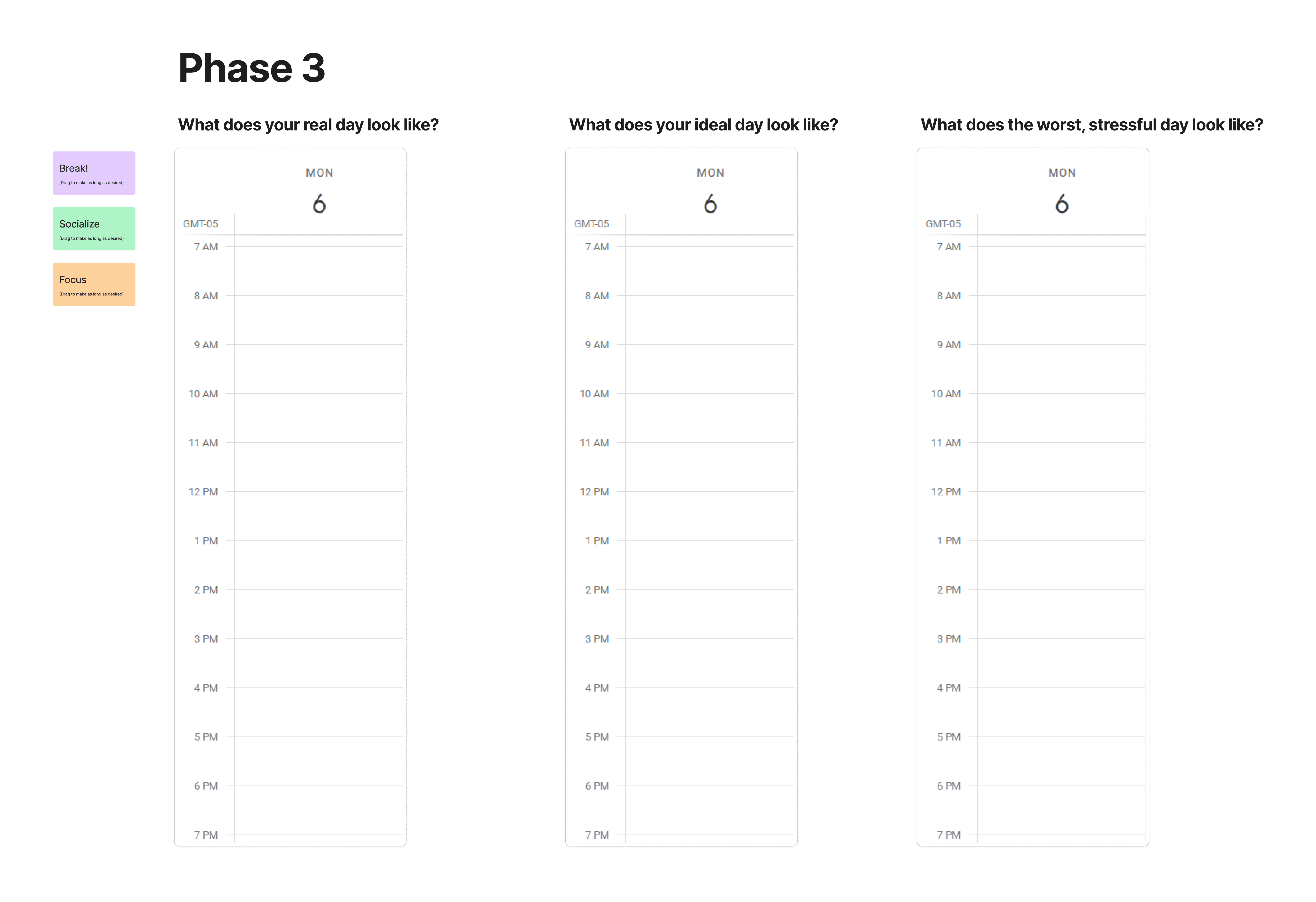
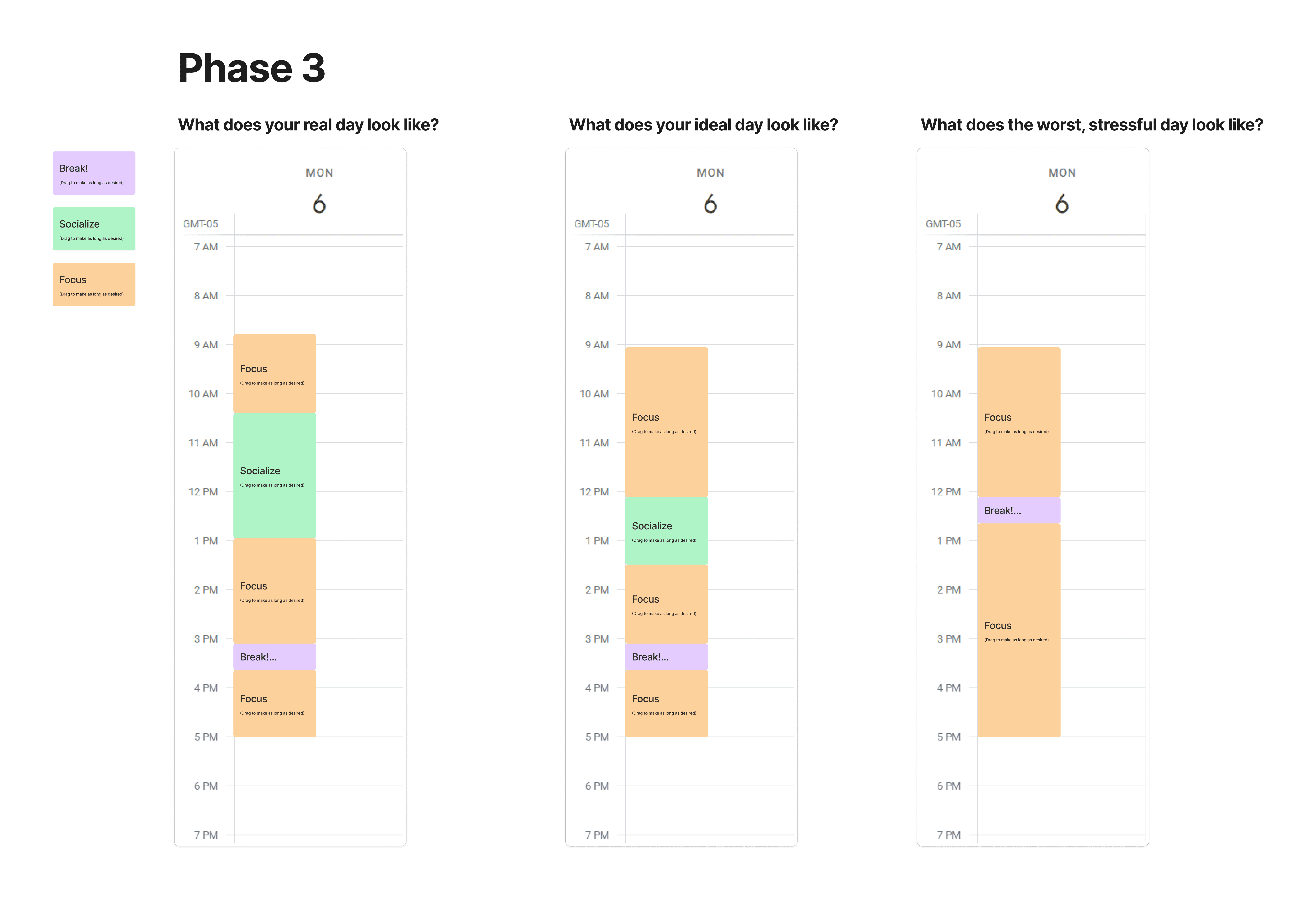
We conducted our workshop remotely with 5 participants, using FigJam as a visual medium for users to interact with. Each session took around 30 minutes with users participating in our planned activities, discussing their thoughts and ideas, and moodboarding out their own designs.
We built a platform that helps remote workers structure their workday to include healthy, restful breaks. It will encourage them to prioritize their health, to form better relationships with their coworkers, and to improve their mental health and stress levels through relaxing activities.
🤝 Foster Stronger Relationships
Our team-building activities and interactive games create opportunities for fun and lighthearted moments, facilitating better communication and camaraderie among team members to foster a supportive and inspiring remote work environment.
😌 Reduce Stress and Boost Mental Health
The carefully curated collection of games not only offer a delightful escape from work but also serve as powerful stress-relievers. Engage in friendly competitions, challenges, and quests with coworkers, and witness the positive impact on motivation, creativity, and stress levels.
🎮 Play, Earn, and Redeem
Each time a game is played, users will earn valuable points. Accumulate these points to use in the Marketplace with a extensive selection of company-provided rewards and prizes, ranging from popular gift cards, company swag, and lunch stipends.